Raag Kirwaniकीरवाणी
Sourced · not yet reviewed by a musician
Sampurna-Sampurna · Night
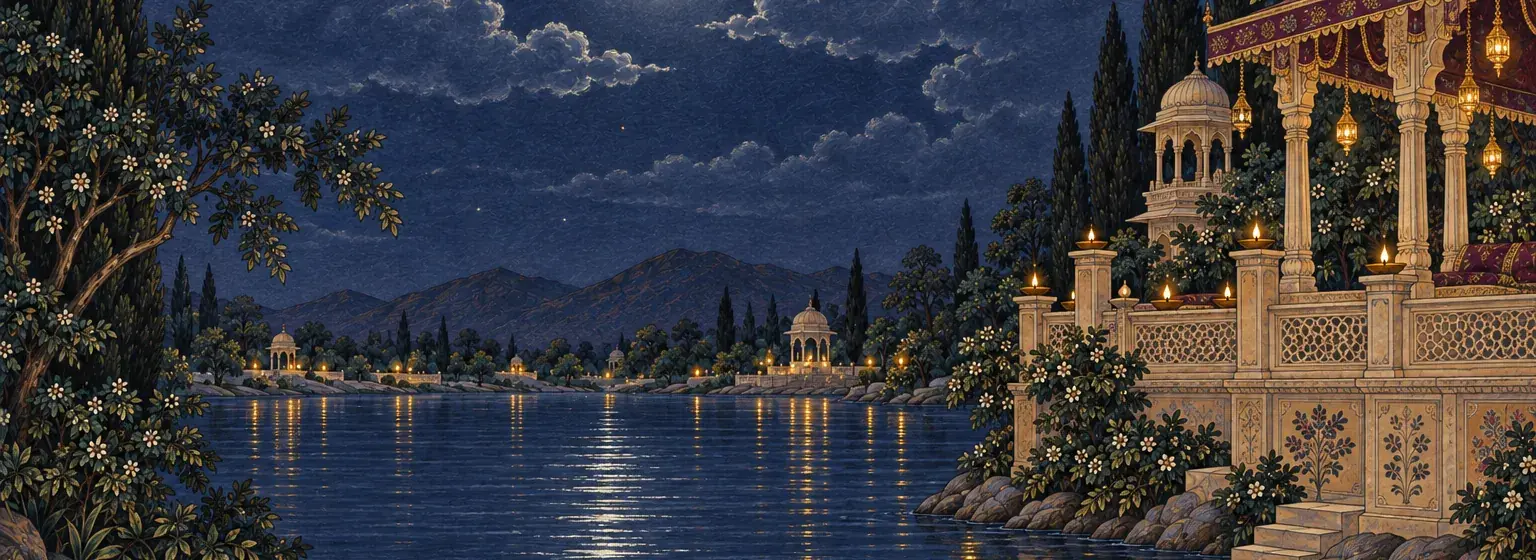
- Early night
- Night
- Midnight
Swaras and phrases
Outlined: vadiVadiThe leading swara in a named raag teaching description. It helps explain note emphasis within that interpretation.Source: N2 §§2.2.6–2.2.9, pp. 17–18.More in the glossary Pa · samvadiSamvadiThe swara ranked next to vadi in a named teaching account. The pair helps describe the raag’s note hierarchy.Source: N2 §§2.2.6–2.2.9, pp. 17–18.More in the glossary Sa
Tap a lit note to hear it · Synthesized for study — not a recording
- ArohaArohaA raag’s ascending note movement in a teaching outline. It is read alongside descending movement and characteristic phrases.Source: N2 §§2.2.3–2.2.4, pp. 16–17; §2.3 answer 1, p. 19; glossary entries 2–3, p. 20 (correcting the apparent ‘Avroha’ typo in §2.2.3).More in the glossary
- Sa Re ga Ma Pa dha Ni Sa'
Source: Artium Academy +3
- Artium Academy, Raag Kirwani page, aroha
- Raga Junglism, Kirwani page, Aroha
- Ragakosh, Raga Kirwani - Learn Thaat, Jaati, Time, Vadi, Samvadi, Aroh, Avroh, Pakad - Powered by Ragakosh, aroha
- Raga Junglism / George Howlett, Kirwani | SRgmPdNS | Hindustani Raga Index | 365+ Ragas, aroha
- All 3 sources agree
- AvarohaAvarohaA raag’s descending note movement in a teaching outline. It may use notes or turns differently from the ascent.Source: N2 §§2.2.3–2.2.4, pp. 16–17; §2.3 answer 1, p. 19; glossary entries 2–3, p. 20 (correcting the apparent ‘Avroha’ typo in §2.2.3).More in the glossary
- Sa' Ni dha Pa Ma ga Re Sa
Source: Artium Academy +1
- Artium Academy, Raag Kirwani page, avaroha
- Ragakosh, Raga Kirwani - Learn Thaat, Jaati, Time, Vadi, Samvadi, Aroh, Avroh, Pakad - Powered by Ragakosh, avaroha
- 2 of 3 sources agree
- PakadPakadA characteristic note phrase that helps identify a raag. A pakad is a useful cue to identity, rather than a substitute for learning the raag’s wider movement.Source: N2 §2.2.5, p. 17.More in the glossary
- Ma Pa Ni Sa Ni dha; Ni dha Pa ga Re
Source: Raga Junglism +1
- Raga Junglism, Kirwani page, Pakad
- Raga Junglism / George Howlett, Kirwani | SRgmPdNS | Hindustani Raga Index | 365+ Ragas, pakad
- 3 versions in 3 sources
About Kirwani
Kirwani comes from the Carnatic raag Keeravani and has the same notes as the Western harmonic minorMinor scaleNotes organised around a tonic with a minor third above it. Natural, harmonic and melodic minor differ especially in their sixth and seventh degrees.Source: AB G2 §3; G3 §3. and 1 moreMore in the glossary scale. The source allows free use of all seven notes; komalKomalThe lowered form of Re, Ga, Dha or Ni relative to its shuddha form. It describes a swara form, not a soft playing instruction.Source: N1 §1.7, pp. 4–5. and 1 moreMore in the glossary Ga, komalKomalThe lowered form of Re, Ga, Dha or Ni relative to its shuddha form. It describes a swara form, not a soft playing instruction.Source: N1 §1.7, pp. 4–5. and 1 moreMore in the glossary Dha and Ni help define it.
Source: Raga Junglism
- Raga Junglism, Kirwani page, opening description
Also called Keeravani.
Source: Raga Junglism
- Raga Junglism, Kirwani page, opening description
Curriculum: not found in the Pracheen Kala Kendra vocal syllabuses we cite.
Learner focus
Hear komalKomalThe lowered form of Re, Ga, Dha or Ni relative to its shuddha form. It describes a swara form, not a soft playing instruction.Source: N1 §1.7, pp. 4–5. and 1 moreMore in the glossary Ga, komalKomalThe lowered form of Re, Ga, Dha or Ni relative to its shuddha form. It describes a swara form, not a soft playing instruction.Source: N1 §1.7, pp. 4–5. and 1 moreMore in the glossary Dha and shuddhaShuddhaThe unmodified form of a swara in Hindustani teaching. Re, Ga, Ma, Dha and Ni can also have specified altered forms.Source: N1 §1.7, pp. 4–5. and 1 moreMore in the glossary Ni together, and Re as a favoured resting note.
Source: Raga Junglism
- Raga Junglism, Kirwani page, notes
Caution
Its notes match the Western harmonic minorMinor scaleNotes organised around a tonic with a minor third above it. Natural, harmonic and melodic minor differ especially in their sixth and seventh degrees.Source: AB G2 §3; G3 §3. and 1 moreMore in the glossary scale, but interpretation is open and there is no fixed pakadPakadA characteristic note phrase that helps identify a raag. A pakad is a useful cue to identity, rather than a substitute for learning the raag’s wider movement.Source: N2 §2.2.5, p. 17.More in the glossary or chalanChalanThe way a raag moves through its notes: characteristic turns, phrases and patterns of emphasis. These behaviours help distinguish raags with similar pitch sets.Source: AM “Rag”. and 2 moreMore in the glossary.
Source: Raga Junglism
- Raga Junglism, Kirwani page, notes
Study prompts
Short exercises that restate what the cited sources say.
- Sing the ascent Sa Re ga Ma Pa dha Ni Sa'.
- Sing Ni dha Pa ga Re and rest on Re.
- Sing Ma Pa Ni Sa and then ga Re Sa. The source hears hints of Pilu in these phrases.
Based on: Artium Academy +7
- Artium Academy, Raag Kirwani page, aroha
- Raga Junglism, Kirwani page, Aroha
- Ragakosh, Raga Kirwani - Learn Thaat, Jaati, Time, Vadi, Samvadi, Aroh, Avroh, Pakad - Powered by Ragakosh, aroha
- Raga Junglism / George Howlett, Kirwani | SRgmPdNS | Hindustani Raga Index | 365+ Ragas, aroha
- Raga Junglism, Kirwani page, Pakad
- Raga Junglism / George Howlett, Kirwani | SRgmPdNS | Hindustani Raga Index | 365+ Ragas, pakad
- Raga Junglism, Kirwani page, notes
- Raga Junglism, Kirwani page, opening description
Variants
- Some artists add touches of komalKomalThe lowered form of Re, Ga, Dha or Ni relative to its shuddha form. It describes a swara form, not a soft playing instruction.Source: N1 §1.7, pp. 4–5. and 1 moreMore in the glossary ni or other outside swarasSwaraA musical note in Indian music. The seven names are Sa, Re, Ga, Ma, Pa, Dha and Ni; some have shuddha, komal or tivra forms.Source: N1 §1.7, pp. 4–5. and 1 moreMore in the glossary.
Source: Raga Junglism
- Raga Junglism, Kirwani page, notes
How the sources vote
Each field shows the version most independent sources agree on. One publisher counts once.
- JatiAll 3 sources agree
- TimeSources split 2–2
- ArohaAll 3 sources agree
- Avaroha2 of 3 sources agree
- Pakad3 versions in 3 sources
- VadiAll 2 sources agree
- SamvadiAll 2 sources agree
Sources differ
Notes where the cited sources describe the raagRaagA recognisable arrangement of notes and musical behaviour that guides melody. A raag’s identity involves how notes are used, not just a list of pitches.Source: N2 §2.1, pp. 14–15; §2.2.1, p. 15. and 1 moreMore in the glossary differently. Field-by-field versions and their sources are under How the sources vote.
- Raga Junglism's printed descent has shuddhaShuddhaThe unmodified form of a swara in Hindustani teaching. Re, Ga, Ma, Dha and Ni can also have specified altered forms.Source: N1 §1.7, pp. 4–5. and 1 moreMore in the glossary Ga, which does not match its own note list with komalKomalThe lowered form of Re, Ga, Dha or Ni relative to its shuddha form. It describes a swara form, not a soft playing instruction.Source: N1 §1.7, pp. 4–5. and 1 moreMore in the glossary Ga, so RagaPedia does not use that descent.
Source: Raga Junglism +2
- Raga Junglism, Kirwani page, Avaroha
- Raga Junglism, Kirwani page, note list under the title
- Raga Junglism, Kirwani page, opening description
Similar raags named by the sources
- Pilu: The scale includes hints of Pilu in Ma Pa Ni Sa and ga Re Sa.
Source: Raga Junglism
- Raga Junglism, Kirwani page, notes
- Chandrakauns: Shared scale hints, with Chandrakauns lacking Re and Pa.
Source: Raga Junglism
- Raga Junglism, Kirwani page, opening description
- Bageshri: The Mewati interpretation is said to contain Bageshri shades, attributed by Howlett to Aarshin Karande.
Source: Raga Junglism
- Raga Junglism, Kirwani page, opening description
Not stated in our sources yet
The sources we cite do not state: thaatThaatA seven-note parent scale used to group Hindustani raags in Bhatkhande’s classification. A thaat is a classification aid rather than a complete raag to perform.Source: N2 §2.1, pp. 14–15; §2.2.1, p. 15. and 1 moreMore in the glossary. RagaPedia leaves these blank rather than guess.
Film songs
Film songs where a checked source names Kirwani. Each song shows whether a musician has reviewed it yet.
Archive recordings
Read the imported recording notes and view artwork in Ragapedia. Programme labels come from Raga Records and await independent musical review. Recovered audio is available in the listening collection. Complete CD audio remains pending.
RAGA-105 · Cassette
Vishwa Mohan Bhatt — New York, 1989
Vishwa Mohan Bhatt (guitar);Sukhvindar Singh (tabla)
Kirwani
Dhun
Stories
Short accounts from the cited sources, paraphrased. Each line says whether it is documented, a named person's account, or uncertain.
Touches of Kirwani in a film thumri
In his 2024 thesis, Punit Jaipal Shah compares Bade Ghulam Ali Khan's thumri with K. J. Yesudas's film adaptation of Ka Karu Sajani in Swami. He describes both as based on Sindhu Bhairavi with touches of Kirwani.
As told by Punit Jaipal Shah, doctoral thesis dated December 2024; local extraction A04 · Source: Chapter 4, section 4.5, printed pp.152-157 (PDF pp.153-158), especially p.153 (PDF p.154), paragraph about Rajesh Roshan borrowing the thumri; local A04.json, Kirwani pair for Ka Karu Sajani
Sources for this profile
ThaatThaatA seven-note parent scale used to group Hindustani raags in Bhatkhande’s classification. A thaat is a classification aid rather than a complete raag to perform.Source: N2 §2.1, pp. 14–15; §2.2.1, p. 15. and 1 moreMore in the glossary, jatiJatiA classification of a raag by its note counts in ascent and descent. Audav means five, shadav six and sampurna seven; the two directions can have different counts.Source: N2 §2.2.2, p. 16.More in the glossary, time, vadiVadiThe leading swara in a named raag teaching description. It helps explain note emphasis within that interpretation.Source: N2 §§2.2.6–2.2.9, pp. 17–18.More in the glossary, samvadiSamvadiThe swara ranked next to vadi in a named teaching account. The pair helps describe the raag’s note hierarchy.Source: N2 §§2.2.6–2.2.9, pp. 17–18.More in the glossary, arohaArohaA raag’s ascending note movement in a teaching outline. It is read alongside descending movement and characteristic phrases.Source: N2 §§2.2.3–2.2.4, pp. 16–17; §2.3 answer 1, p. 19; glossary entries 2–3, p. 20 (correcting the apparent ‘Avroha’ typo in §2.2.3).More in the glossary, avarohaAvarohaA raag’s descending note movement in a teaching outline. It may use notes or turns differently from the ascent.Source: N2 §§2.2.3–2.2.4, pp. 16–17; §2.3 answer 1, p. 19; glossary entries 2–3, p. 20 (correcting the apparent ‘Avroha’ typo in §2.2.3).More in the glossary and pakadPakadA characteristic note phrase that helps identify a raag. A pakad is a useful cue to identity, rather than a substitute for learning the raag’s wider movement.Source: N2 §2.2.5, p. 17.More in the glossary show the version the most independent publishers print; the sources page lists every version and who prints it. Other facts follow the source cited beside them. No musician has reviewed this profile yet.
- Raag KirwaniArtium Academy · cited as Artium AcademyA private music academy's raag page. Its terms reserve reproduction, so it is cited and paraphrased only. Accessed 7 October 2026.
- KirwaniRaga Junglism (George Howlett) · cited as Raga JunglismA practitioner's raag guide, used because the institutional sources we checked have no Kirwani profile. Its printed descent contradicts its own note list, so that descent is not used. Accessed 7 October 2026. Located by line; paraphrased.
- Hindustani Music (242), Theory Book 1, Chapter 2: Elements of RagaNational Institute of Open Schooling · cited as NIOSDefines the jati terms used to label note counts. Accessed 7 October 2026. Located by printed page; paraphrased.
- Raga Kirwani - Learn Thaat, Jaati, Time, Vadi, Samvadi, Aroh, Avroh, Pakad - Powered by RagakoshRagakosh · cited as RagakoshRobots checked (B-ROBOTS-RAGAKOSH.txt): explanatory content-signal comments only, no disallow rule or AI-input prohibition printed. No terms link found in public navigation/help, and /terms returned 404 (B-TERMS-RAGAKOSH.txt). Only visibly public factual text is used. Playback requires Pro and was not accessed; no login or account was used. HTML/text is private audit evidence; no open license claimed. Accessed 17 October 2026.
- In the Footsteps of Babur: Musical Encounters from the Lands of the Mughals, Music of Central Asia Vol.9, SFW CD 40528Smithsonian Folkways Recordings / Aga Khan Music Initiative · cited as Smithsonian FolkwaysAlbum booklet note on a Kirwani performance. Cited and paraphrased only. Accessed 7 October 2026.
- Kirwani | SRgmPdNS | Hindustani Raga Index | 365+ RagasRaga Junglism / George Howlett · cited as Raga Junglism / George HowlettPublic original musicology by George Howlett; robots permits these raag paths (B-ROBOTS-RAGAJUNGLISM.txt). About/index and page navigation checked: open-access, AI-free authorship described, no open reuse license or restriction on this local factual audit found. Short field transcriptions with attribution only; HTML/text remains private audit evidence. No media downloaded. Accessed 17 October 2026.
- Rakesh Chaurasia | Raag Kirwani - Romantic Ragas - Darbar PlayerDarbar · cited as DarbarPublic concert-description text only. Robots allows this public page (B-ROBOTS-DARBAR-PLAYER.txt); Darbar terms were reviewed in B-TERMS-DARBAR.txt and the Player /tos endpoint was checked (B-TERMS-DARBAR-PLAYER.txt, no readable terms body). Only factual public metadata is cited. The video requires a subscription and was not played or downloaded. Private audit evidence only; no open license claimed. Accessed 17 October 2026.